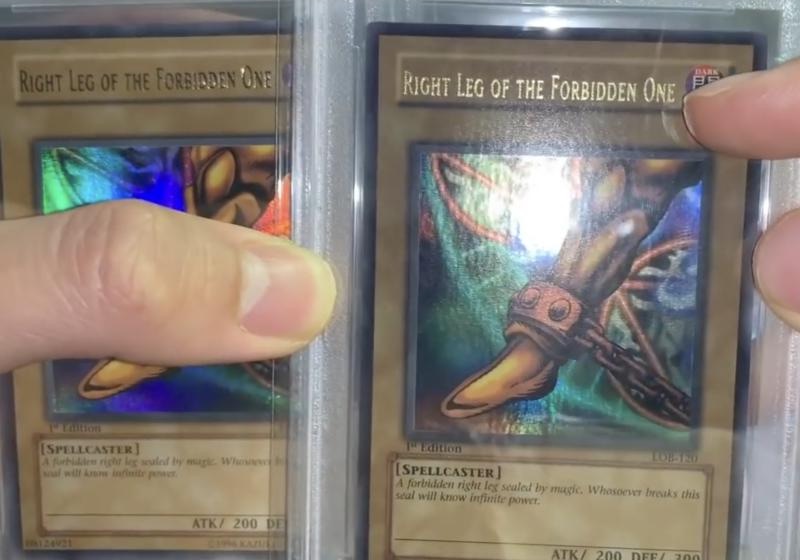
Two 1st Edition Right Leg of the Forbidden One: glossy on the left, wavy on the right. Image from kanyewest315's video.3
What the names mean
Wavy and glossy are the nicknames for two types of paper used in the North American Legend of Blue Eyes White Dragon (LOB), released on March 8, 2002.1 A glossy card has a smooth, highly reflective front. A wavy card has vertical ripples running across the whole card and a duller shine.4
Don't confuse it with a warped card. Warping is the whole card curling, something that hits foils from any set when humidity changes. Collectors explain that the paper absorbs moisture and the foil layer doesn't, so the two pull in different directions.14 A wavy card can be perfectly flat and still be wavy, because the ripples are part of the surface.
The variation runs across every rarity in the set, from Commons to Secret Rares, with one exception we'll get to below. On foils the effect jumps out at you. On Commons it's much subtler: the wavy just looks flatter and the glossy a bit shinier.813
Where each one shows up
The split only exists on North American English cards. Asian English and the German, French and Spanish editions used a single paper.3 In 1st Edition, wavy appears only in LOB. The Yugi and Kaiba Starter Decks, released on March 29, 2002, are all glossy in 1st Edition.134 In Unlimited, both finishes exist in both LOB and the Starter Decks.
LOB 1st Edition came out in three known boxes: a wavy hobby box with Tri-Horned Dragon as the Secret Rare, a glossy hobby box with the same card, and a glossy retail box with Gaia the Dragon Champion.2 With no wavy retail box, Gaia was pretty much limited to glossy. There are one or two known wavy copies, which don't come from regular boxes.49
 LOB-000
 LOB-125
After LOB, the trail gets murky. Metal Raiders, from June 2002, has a light texture that matches neither finish.13 In between there's also what some collectors call the "1.5 print": Unlimited with the wavy ink, but without the ripples and with a rougher back, like Metal Raiders.45 So not every Unlimited card with some texture is wavy.
Why it happened
Neither Konami nor Upper Deck, the distributor at the time, explained it in anything we could find. PSA treats the variation as something that probably wasn't planned.2 The most detailed explanation comes from collector Schloast and proposes two independent production lines.5
- Different materials. Wavy would have a foil layer with plastic, applied like a sticker. On glossy the foil would be part of the paper itself, which would make the card lighter and more fragile.
- Different defects. Wavy cards tend to be missing magenta, the famous "faded" look. Glossy cards have foil lines and small foil shifts. If each paper has its own errors, they would come from different printers.
- Different boxes. The small "1st Edition" on the wavy box is the visible part, but logos and text also shift slightly. That suggests two separate layouts.
Tony Ghezzi, a PSA consultant, also bets on different printing plants, and admits his theory about the reason still lacks sources.6 The two-printer idea has good evidence. The why remains speculation.
 Glossy box
 Wavy box
Which came first?
For years, wavy was synonymous with "first print." The idea still showed up in an auction in 2023.410 In 2019, a video gathered the counterarguments: a wavy-only release wouldn't have Gaia, an official part of the set; the 1st Edition Starter Decks are all glossy; and the small lettering on the wavy boxes is what carried on into the following sets.3
Schloast pushed back on part of that in 2021. To him, the small lettering is just how each printer did it, with no chronological meaning. The two lines would have run at the same time, and wavy would have come out only in hobby boxes.5 Strictly Sealed, in 2024, still saw glossy as the first print.9
There's only one order with physical proof, and it applies to Unlimited. Trial of Hell was renamed Trial of Nightmare, and the old name in Unlimited only appears on glossy.59 So Unlimited glossy came before Unlimited wavy.
 LOB-012 · Unl
 LOB-012 · Unl
Neither one is a reprint of the other: both are genuine 1st Edition.
Value and grading
At the top of the market, wavy usually costs more. The gap varies a lot by card and date:
| Reference | Wavy | Glossy | When |
|---|---|---|---|
| Blue-Eyes White Dragon PSA 10 | $60,00011 | about $43,20012 | May 2026 |
| Blue-Eyes White Dragon PSA 10 | about $8,000 (projection) | about $6,000 | 20193 |
| Red-Eyes Black Dragon PSA 10 | wavy close to double | 20215 | |
| Flame Swordsman ungraded | about $2,000, reported | about $1,000, reported | 20249 |
| Commons | no meaningful difference | 20249 |
The reason changed over time. Once the "first print" theory lost steam, scarcity and looks were what remained. The most repeated estimate says wavy makes up about a third of 1st Edition, but it's a hypothesis: nobody has confirmed the number.211 There's also taste: the darker colors favor Red-Eyes Black Dragon and Flame Swordsman.9 And the rule has an exception. Strictly Sealed considers the glossy Tri-Horned Dragon the scarcer one, and Schloast pointed to PSA 10 sales possibly above the wavy.59
In grading, wavy and glossy show up in auction titles, but we found no sign that PSA separates the two on the label. In 2020, a collector who says he sent about 10% of all LOB to PSA reported that wavy is much easier to grade, and that a Common graded 10 is probably wavy.13 That's a firsthand account, with no public data. Faded cards also need attention: there are complaints about copies with factory defects being treated as sun damage. According to that account, the difference would be in the print rosettes, where one color would be missing instead of all of them looking washed out.8
Open questions
- How many wavy cards exist? We found no published print run for either paper.
- Who printed them? We found no printing plant publicly identified.
- Does the Summoned Skull sample prove anything? One side uses the sample card, dated December 2001, as proof for glossy. Schloast says the real prototype uses OCG paper.35
- American wavy, European glossy? A 2026 grading guide claims this, with glossy being more expensive.15 PSA and collector sources place both papers in the North American set, so we treat that version as an error.
To see the cards move under the light, Petiparty's video listed in the sources shows the differences well.
Comments
none yetCreate your free account to comment and save the cards from this article.
Get the next stories
One collection story every two weeks, straight to your inbox. Just reading, no ads.
You can unsubscribe anytime, in one click. See our Privacy Policy.