
One card a month
The Hobby League was the everyday competition: a group of players battled for small prizes at the store, with a monthly prize for the best record. Just for taking part, a player got an exclusive card, and that card changed every month.2 The card program ran from 2004 to 2008.
The catalog lists seven series and 43 English cards.1 It's a small set, which helps if you want to complete it. The dates below go month by month, and series 4 has a few odd spots, covered under the open questions.
| Series | Period | Cards | Rarity | Standout card |
|---|---|---|---|---|
| HL1 | Oct 2004 to Feb 2005 | 6 | Common and Super Rare | King of the Swamp |
| HL2 | Jan to Jun 2006 | 6 | Ultra Parallel Rare | Cyber Jar |
| HL03 | Jul to Dec 2006 | 7 | Ultra Parallel Rare | Royal Decree |
| HL04 | 2007 | 6 | Ultra Parallel Rare | Graceful Charity |
| HL05 | Jul to Dec 2007 | 6 | Ultra Parallel Rare | Crystal Beast Ruby Carbuncle |
| HL06 | Jan to Jun 2008 | 6 | Ultra Parallel Rare | Reinforcement of the Army |
| HL07 | Jul to Dec 2008 | 6 | Ultra Parallel Rare | Monster Reborn |
The series that got the most expensive
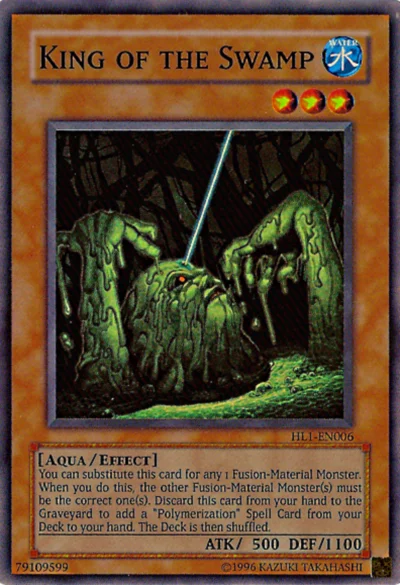
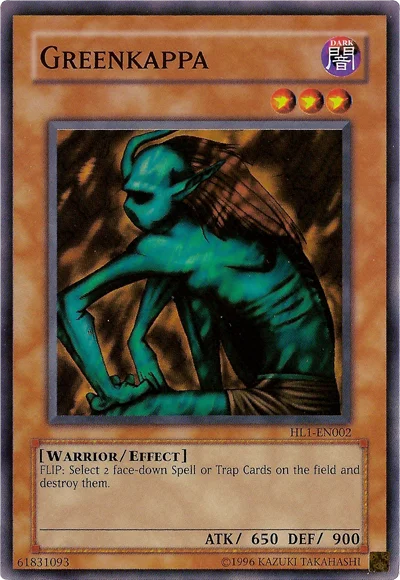
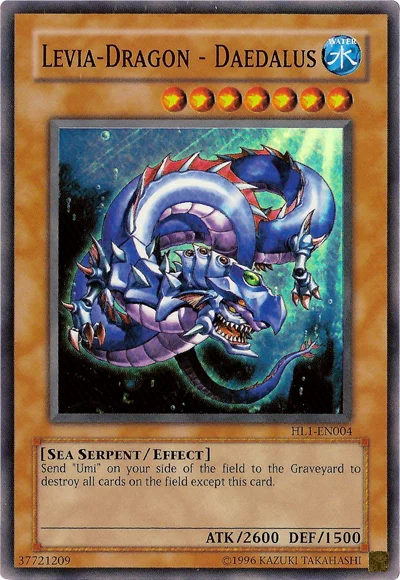
The first series is different from all the others. It came out in three waves, each with one Common and one Super Rare, and it didn't have the parallel finish yet. The card choices break the pattern too: Lord of the Lamp, for example, is a Normal Monster with only three English printings.1
 HL1-EN006
 HL1-EN002
 HL1-EN004
Even so, it's the most valuable series. In July 2023, collectors pointed to King of the Swamp as the most expensive card in the whole Hobby League, at around $50, with near mint copies reaching $80 or $90. Greenkappa sat near $30 and Levia-Dragon - Daedalus between $30 and $40.3 Those prices are three years old, useful only to show how the cards rank against each other.
What an Ultra Parallel Rare is
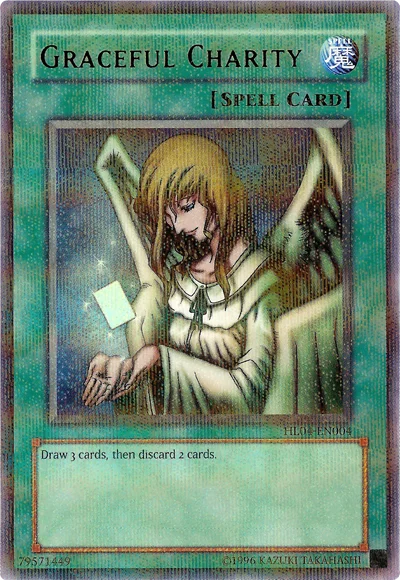
Starting in January 2006, with Cyber Jar, the cards switch to Ultra Parallel Rare. In the catalog, it's the first appearance of that rarity in English.1 The base is a regular Ultra Rare, with a gold name and shiny artwork. On top of it sits a film with parallel lines that covers the front of the card.
According to collectors, that film is an extra layer applied over the card. That has three effects: the card gets thicker, the front scratches easily, and the layer tends to peel at the edges, often just from the friction of sliding in and out of a sleeve.3 The back is usually fine. The problem is the front.
The layer that made the card special is also what ruins it.
The thickness also put some players off. Collectors say many avoided using these cards at official tournaments, afraid a judge would call the deck marked.3 We found no official ban, so this stands as a reported worry, with no rule behind it.
Staples in a new outfit
From series 2 on, the list is almost entirely reprints of cards that saw heavy play at the time: Graceful Charity, Royal Decree, Reinforcement of the Army and others. That makes the Hobby League a collection tied more to the Goat format player than to the anime fan.
It also explains why prices are low. In 2023, most of the cards sat between $5 and $20, and almost every card in the series had a high-rarity competitor in a main set.3 Royal Decree is the clearest example: the Ultra Rare version from Tournament Pack 4 was worth many times more. In series 5, Crystal Beast Ruby Carbuncle showed up as the most sought-after card.
 HL04-EN004
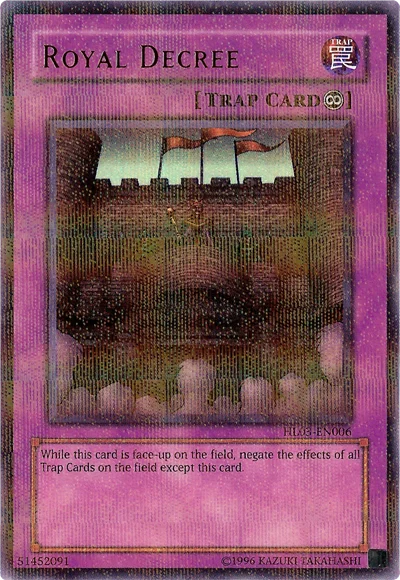 HL03-EN006
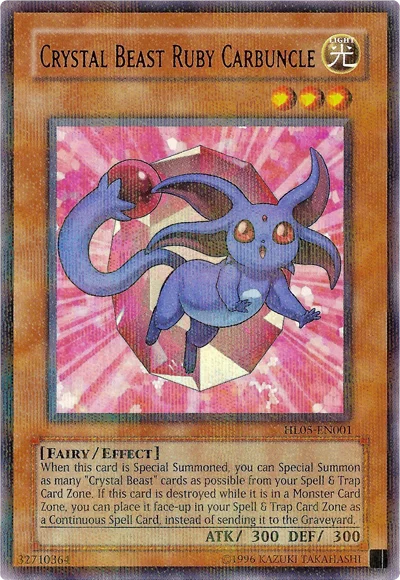 HL05-EN001
Among collectors, series 2 through 4 and series 6 are known for strong colors, similar to the Asian English printings. Series 5 is said to be lighter. Series 7, the last one, gets the most criticism: the shine looks patchy and the cards resemble fakes.3 Monster Reborn was the highlight of that series, at about $20 to $25 in 2023. The catalog still lists series 7 as Ultra Parallel Rare.
Other languages
In the catalog, series 1 through 5 exist only in English. Series 6 also appears in German, French, Italian and Spanish, with all six codes in each language. Series 7 repeats that for the first four cards only.1 Dates are missing for these versions, and several have no image, especially in Spanish.
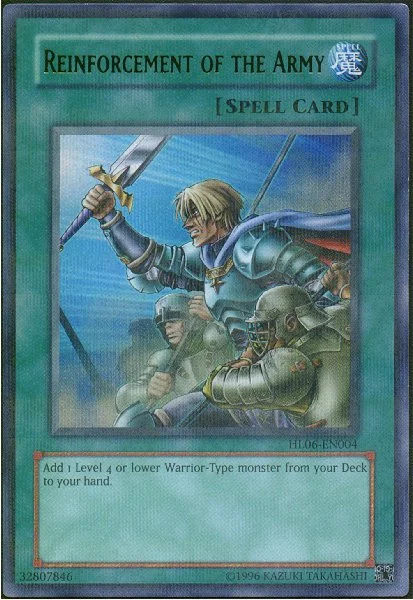 HL06-EN004
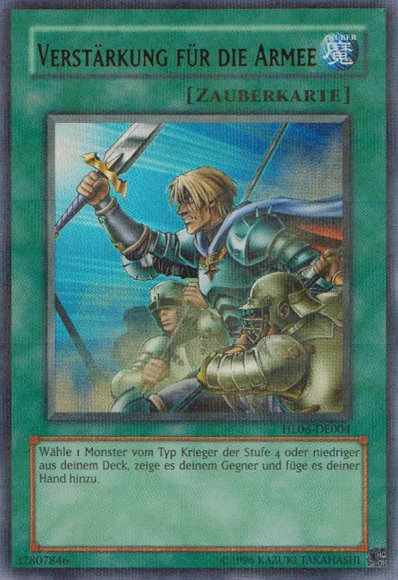 HL06-DE004
Open questions
- Print run. We found no published number for any series.
- Where the cards were made. The idea that series 1 uses Japanese factory card stock and the others were printed differently comes from collectors. Konami hasn't confirmed it.
- Series 4 calendar. The catalog places two cards in August and November 2007, when series 5 was already circulating. It could be a date error or out-of-order distribution.
- Series 7 finish. Collectors see a clear difference. Our sources don't say whether the process changed or just the quality control.
To see the cards up close, including the texture of the finish, check out the video from the Strictly Sealed channel, listed in the sources.
Comments
none yetCreate your free account to comment and save the cards from this article.
Get the next stories
One collection story every two weeks, straight to your inbox. Just reading, no ads.
You can unsubscribe anytime, in one click. See our Privacy Policy.