
Before the anime, before the TCG
Forbidden Memories came out in Japan on December 9, 1999, under another name: Yu-Gi-Oh! True Duel Monsters: Sealed Memories. That was four months before the Duel Monsters anime premiered.14 Konami developed and published the game, directed by Morikuni Kubo.4
It took more than two years to reach the United States. It arrived on March 19, 2002, together with Dark Duel Stories, and the two were the first games in the franchise released there.4 It was the same month the TCG launched in the US: Legend of Blue Eyes White Dragon came out on March 8.8 In Europe, the dates vary by country. The European dates in the table come from Yugipedia.112
| Region | Release |
|---|---|
| Japan | December 9, 1999 |
| North America | March 19, 2002 |
| United Kingdom and Italy | November 22, 2002 |
| Germany | November 27, 2002 |
| France | March 7, 2003 |
| Australia | April 21, 2003 |
Sources disagree on the European dates: PSXDataCenter confirms November 22, 2002 for the English PAL version, while Wikipedia lists March 7, 2003 for Europe.124
Critics weren't impressed. The Metacritic score landed at 57, GameSpot gave it 5.9, and the Official U.S. PlayStation Magazine gave it 1.5 out of 5. The complaints were the lack of a tutorial and the uneven difficulty.4 Players ignored all that: it sold 510,804 copies in Japan and 2 million in the United States and Europe by 2004.4
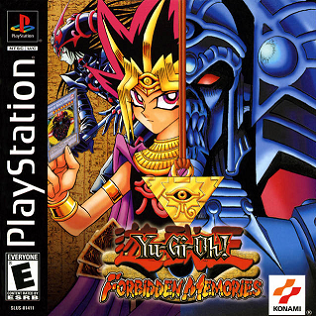 SLUS-01411
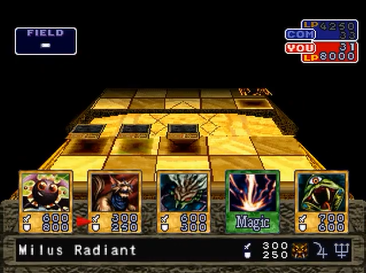 Duel screen
The story
The player starts as Prince Atem, in ancient Egypt. The high mage Heishin storms the palace with a dark power, and Simon Muran seals the prince's soul inside the Millennium Puzzle. In the modern era, Yugi assembles the puzzle and enters a Kaiba Corporation tournament to gather the Millennium Items. With them, Atem returns to the past to face the high mages in their shrines and, finally, reach the Forbidden Ruins.1
How it played
The game doesn't use the card game's rules. It inherits the system from the Game Boy titles, and the card list is nearly a copy of the one in Duel Monsters II: Dark Duel Stories. Of the 722 cards, 720 come from there.1 A deck has exactly 40 cards, with up to three copies of each. Each player starts with 8000 LP and draws up to five cards in hand. Every monster is a Normal Monster, with no effects.1
Fusions
On your turn, you play one card or try a combination of several from your hand, in the order you choose. The game tests the first two, then the result with the next one, and so on. An invalid combination discards a card.1 Fusion happens straight from the hand or onto a monster on the field, and it works in pairs of cards: Baby Dragon plus Bolt Penguin becomes Thunder Dragon.5 The table extracted from the game has about 25,000 combinations, and nothing in the game teaches them. That's why critics talked about trial and error.45
Guardian Stars
Each monster has two Guardian Stars, and you pick one when you play it. Whoever has the advantageous star gains 500 ATK and DEF in battle. There are two separate cycles:15
- Sun beats Moon, Moon beats Venus, Venus beats Mercury, Mercury beats Sun.
- Mars beats Jupiter, Jupiter beats Saturn, Saturn beats Uranus, Uranus beats Pluto, Pluto beats Neptune, Neptune beats Mars.
The system came from the affinities in Duel Monsters II.1 The field matters too: Field Magic changes the terrain and gives or takes 500 from certain monsters. Equip cards add 500 per bonus level.1
Starchips and passwords
Each win earns a card and 1 to 5 Starchips, depending on your duel rank. The rank also decides which of the opponent's drop lists the prize comes from: there's one for S and A in Power, another for S and A in Technical, and another for B, C and D.1
Starchips buy cards through the password menu, using the eight digits printed in the corner of real cards. This is where the physical collection met the game. The catch: 98 cards cost 999,999 Starchips, and 24 don't even have a password.56 At the maximum rate of 5 per win, 999,999 Starchips takes 200,000 duels.
In Japan there was another route: the PocketStation, with its own fusions and a lottery using passwords published in V Jump. The accessory was only released there, and outside Japan some cards were nearly out of reach.1
Red-Eyes Black Metal Dragon is the only one of the five promos that isn't in the game.
The physical cards: each region, its own story
Japan: five cards, three per box
The set has five cards. According to Yugipedia, each copy of the game came with three of them at random; a Japanese column says this applied to the first production run.310 There are three Ultra Rares and two Secret Rares, none with a code in the catalog.38
| Card | Rarity | In-game No. |
|---|---|---|
| Red-Eyes Black Metal Dragon | Secret Rare | Not in the game |
| Metalzoa | Secret Rare | 392 |
| Zoa | Ultra Rare | 391 |
| Harpie's Pet Dragon | Ultra Rare | 386 |
| Metalmorph | Ultra Rare | 658 |
Red-Eyes Black Metal Dragon is among the promos, but not among the 722 cards.15 There is a Metal Dragon in the game, number 409, but it's a different monster. The other four are in there, all at 999,999 Starchips: holding the card and typing in the password didn't get you very far.5
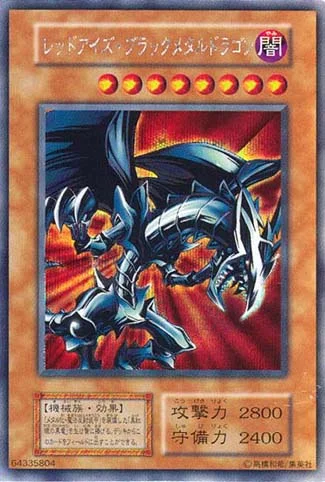 Japan · ScR
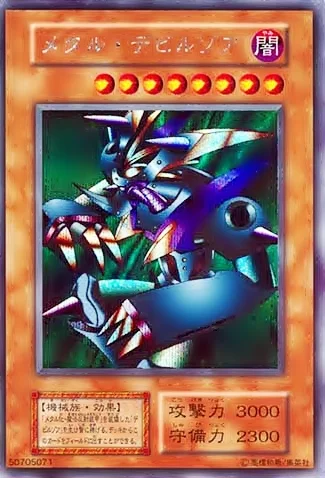 Japan · ScR
There was also a sixth physical card. The V Jump Books guide came with an Ultra Rare Black Magic Ritual.13 It matches the game's Dark Magic Ritual (721), which summons Magician of Black Chaos (722). Those two are the only additions compared to Duel Monsters II.1 The magician had already existed on paper since August 1999, as an attendance card from the Tokyo Dome event.8
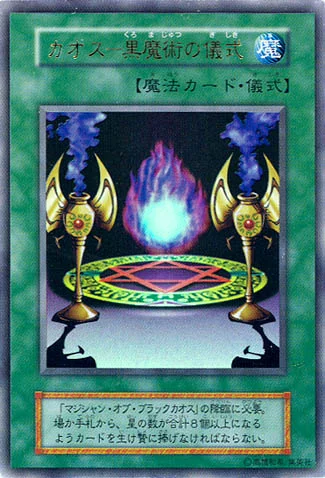 Guide · UR
North America: only in the Premium Edition
The March 2002 version came with no cards. They arrived with the Premium Edition, in November 2002: three Prismatic Secret Rares with the codes FMR-001, FMR-002 and FMR-003.12 Zoa and Metalzoa were left out.
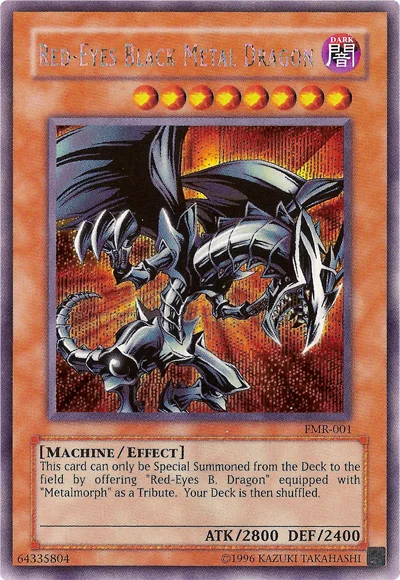 FMR-001
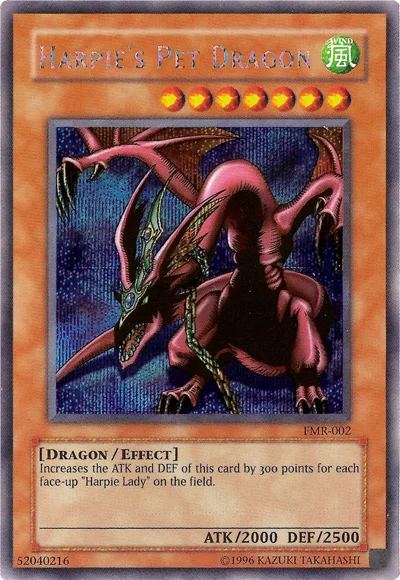 FMR-002
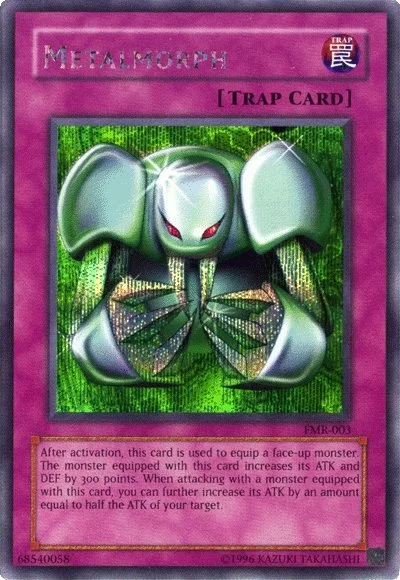 FMR-003
Europe: nothing in the box, with a detour through Spain
The European versions of Forbidden Memories came with no cards.1 The trio showed up in Spanish later, through a different game: the Spanish boxes of The Sacred Cards, in February 2004, included TSC-S001, TSC-S002 and TSC-S003. The other European languages got Exchange, Graceful Dice and Skull Dice.89
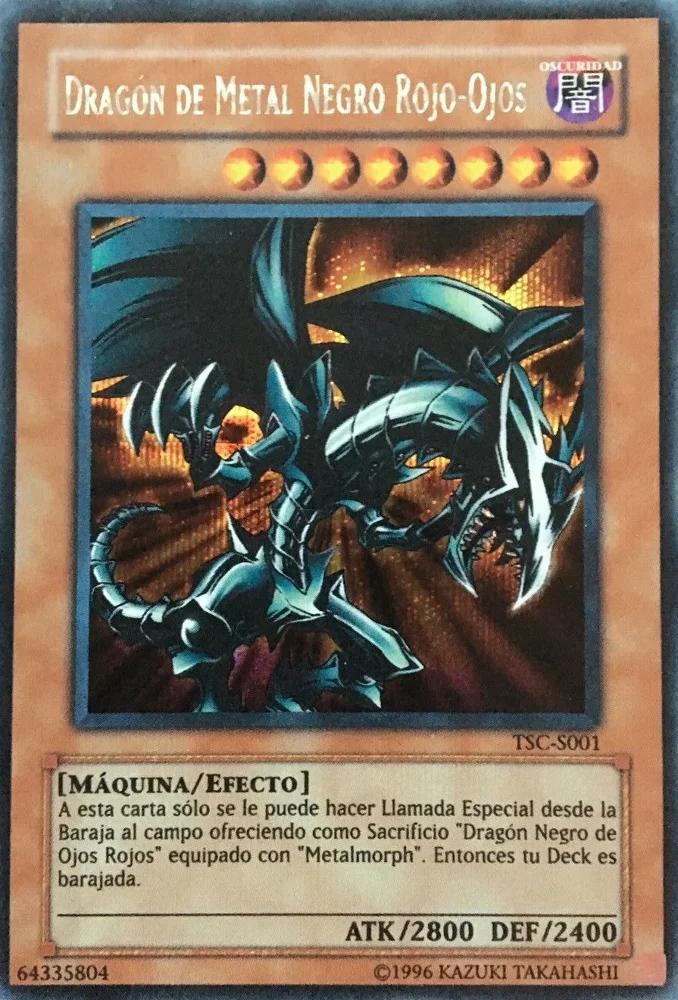 TSC-S001
Reprints
All five came back later in other products. In Japan, Metalmorph and Red-Eyes Black Metal Dragon came out in Premium Pack 5, in December 2001, with the codes P5-06 and P5-07. In English, Zoa and Metalzoa debuted in The Falsebound Kingdom bundles, in November 2003, as TFK-001 and TFK-002, also in Prismatic Secret Rare. After that, all five were reprinted in English, including in Legendary Collection 4.8
Open questions
- Did every Japanese copy come with cards? Yugipedia says each copy had three. A Japanese column talks about the first print run only.310 We found no Konami document on this.
- Print run. Konami published no numbers. The same column estimates 150,000 to 200,000 copies of each Secret Rare, based on sales of about 500,000.10 That's the author's guess, and it assumes cards in every box.
- Odds for each card. The column says the Secret Rares came in fewer boxes.10 There's no confirmed rate.
- Premium Edition date. The press release cited by Yugipedia is dated November 26, 2002. The game's page says the 25th, and Konami's database records the cards on March 20, 2002.12
- Premium Edition print run. No source gives this number.
Why it's hard to find
The Japanese cards may have come out in large numbers, if they followed the half million copies sold. The FMR cards, on the other hand, depend on an edition released eight months after the regular game, only in North America. On November 2, 2026, the CardShopFinder aggregator showed a Near Mint FMR-001 at about $217, and a Moderately Played one at about $87.11 These are reference prices, not completed sales. We found no reliable price for the Japanese cards or for a sealed box.
Full list: all 722 cards
The count of 722 cards, numbered 001 to 722, appears on Yugipedia and in both databases extracted from the game. There's also a story card, the Millennium Item Card, which isn't used in duels.1567 That's 621 monsters, 67 Magic (27 regular, 6 Field and 34 Equip), 10 Trap and 24 Ritual.15
The table uses the in-game names, which sometimes differ from the card game: Red-eyes B. Dragon, Dimensional Warrior. In Password, a dash means the card has no password. In Starchips, the value is the cost in the password menu.
| No. | In-game name | Type | Level | ATK | DEF | Guardian Stars | Password | Starchips |
|---|---|---|---|---|---|---|---|---|
| 001 | Blue-eyes White Dragon | Dragon | 8 | 3000 | 2500 | Sun / Mars | 89631139 | 999,999 |
| 002 | Mystical Elf | Spellcaster | 4 | 800 | 2000 | Sun / Jupiter | 15025844 | 160 |
| 003 | Hitotsu-me Giant | Beast-Warrior | 4 | 1200 | 1000 | Moon / Mars | 76184692 | 70 |
| 004 | Baby Dragon | Dragon | 3 | 1200 | 700 | Uranus / Sun | 88819587 | 999,999 |
| 005 | Ryu-kishin | Fiend | 3 | 1000 | 500 | Saturn / Sun | 15303296 | 30 |
| 006 | Feral Imp | Fiend | 4 | 1300 | 1400 | Moon / Jupiter | 41392891 | 140 |
| 007 | Winged Dragon #1 | Dragon | 4 | 1400 | 1200 | Saturn / Moon | 87796900 | 999,999 |
| 008 | Mushroom Man | Plant | 2 | 800 | 600 | Jupiter / Sun |
Comments
none yetCreate your free account to comment and save the cards from this article.
Get the next stories
One collection story every two weeks, straight to your inbox. Just reading, no ads.
You can unsubscribe anytime, in one click. See our Privacy Policy.