
What a match winner is
World Championship prize cards almost always follow the same idea. The text says that if the monster attacks directly and brings the opponent's Life Points to zero, its owner wins the whole Match, the best of three, not just the Duel. Hence the nickname "match winner." Ulevo, for example, can't be Special Summoned and requires three Winged Beast monsters as Tribute.1
The effect already existed on a regular collectible card: Victory Dragon, released in Japan in April 2003 in Limited Edition 5: Kaiba Pack.1 The World Championship prizes took the idea to cards made only for the winners, and those cards aren't legal in official tournaments.3
2003: three codes, one card seen
The first World Championship took place on August 10, 2003, at Madison Square Garden in New York.2 The print run guide the community cites most lists three codes for that year: Kanan the Swordmistress (WCS-001), Victory Dragon (WCS-002) and Black Luster Soldier (WCS-003).2
Only Kanan ever surfaced. It's an Asian-English Super Rare, recorded in the catalog as a participation card from the Japanese qualifier in July 2003 and as a top 100 prize in Season 3 of the Duelist King Tournament.1 The estimate is about 1,600 copies.2 For the other two, the guide notes 1 or 2 copies and warns there's no evidence they were ever handed out. As of 2023, collectors knew of no photo of either.3
2004 and 2005: the format is born
In 2004 the World Championship moved to Southern California, on July 25, with two sides: the card game and the video game, played on the Game Boy Advance.25 Konami never published how many copies of each prize it handed out. Community guides do the math from the top four on each side, but there's no official document, and sources disagree on who received the runner-up card.3
The codes tell the story: in WCS-EN401, the 4 is the year and the 01 is the placing. The two 2004 cards were Ulevo and Meteo the Matchless, both Ultra Rare.1
The packaging became part of the prize. The card sat loose between two black acrylic plates. The screws on the back are fake and the case is glued, so the only way out is to break it. It came with a resin plaque in a wooden frame, gold, silver or bronze depending on the placing, with the winner's name.3
2005, in Tokyo, repeated the model with King of Destruction - Xexex and Queen of Fate - Eternia.2 Collector accounts add a perk: a shikishi drawn and signed by Kazuki Takahashi.3
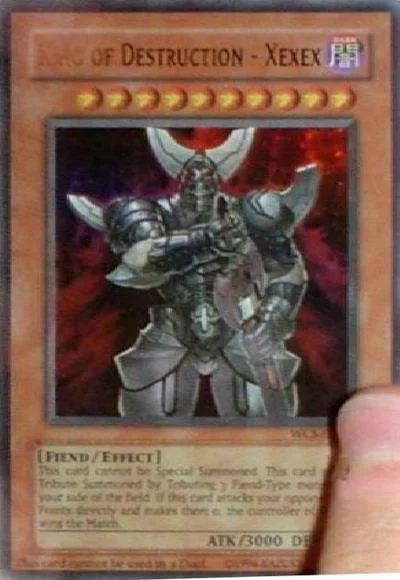 WCS-EN501
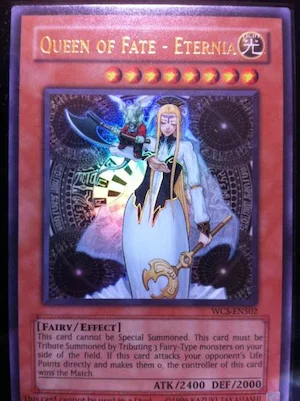 WCS-EN502
The qualifier cards
In parallel, Asia got Asian-English Super Rares, with print runs in the thousands or the hundreds. They come sealed in clear plastic, with no acrylic.3 In the early years, Konami reprinted old Japanese cards: Sengenjin (2004) and Firewing Pegasus (2005), from the 1999 Tokyo Dome tournament, and Seiyaryu (2006), a 1998 giveaway from the Game Boy game's trial event.1
Don't confuse WCS-AE403 with WCS-EN403. The English version is more common, and the catalog dates it to May 22, 2004, the day 671 Toys "R" Us stores in the United States held the video game preliminaries. The news story from the time says every participant would get an exclusive card, without naming it.15
2006 to 2009: the WCPS code and the reprints
In 2006 the prefix changed to WCPS, and everything else stayed the same: Testament of the Arcane Lords and Armament of the Lethal Lords, in black acrylic, with the resin plaques.4
The shift came in 2007, in San Diego. Chimaera, the Master of Beasts and Emperor of Lightning kept the format, but the qualifier card became the previous year's champion card, with the same artwork, as a Super Rare. Testament came out that way in 2007, Chimaera in 2008, Tyr, the Vanquishing Warlord in 2009 and Aggiba, the Malevolent Sh'nn S'yo in 2010.1
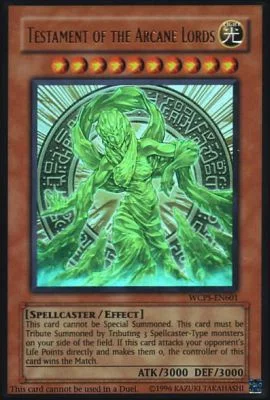 WCPS-EN601
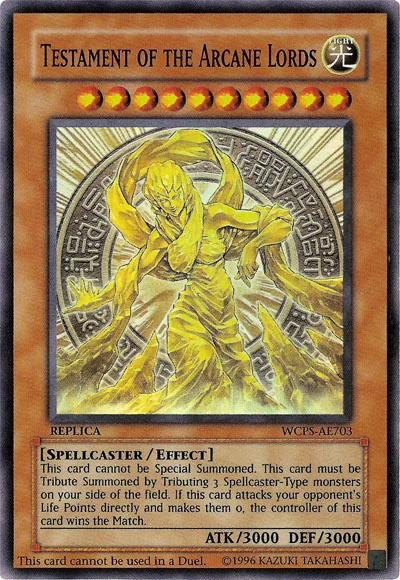 WCPS-AE703
The runner-up card was left out. In the catalog, Armament of the Lethal Lords, Emperor of Lightning, Lorelei, the Symphonic Arsenal and Skuna, the Leonine Rakan each have a single printing.1
Starting in 2007, the runner-up artwork became rarer than the champion artwork.
Also in 2007, Get Your Game On! (WCPS-EN700) was given to everyone who attended the event.4 In 2008, in Berlin, the black acrylic gave way to a clear case, and the resin plaques disappeared. Tyr, the Vanquishing Warlord and Lorelei, the Symphonic Arsenal opened that phase. The WCPS series ended in 2009, in Tokyo, with Aggiba and Skuna. In 2010 the code became 2010-EN001.24
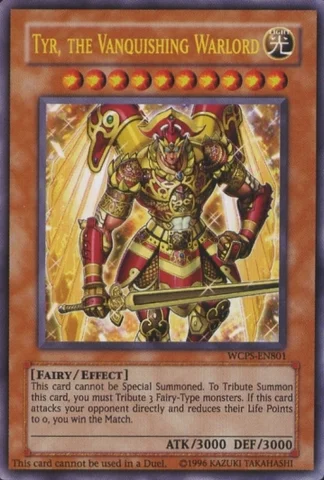 WCPS-EN801
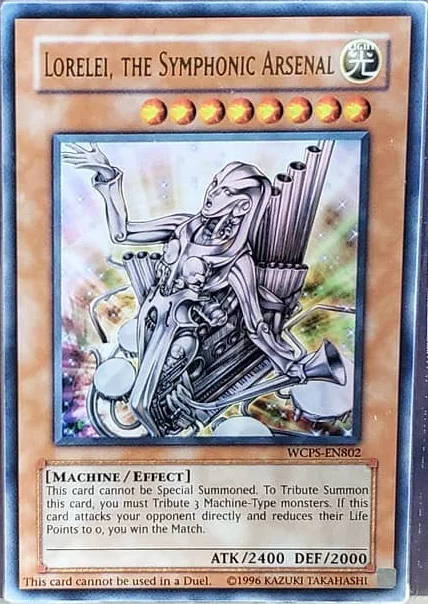 WCPS-EN802
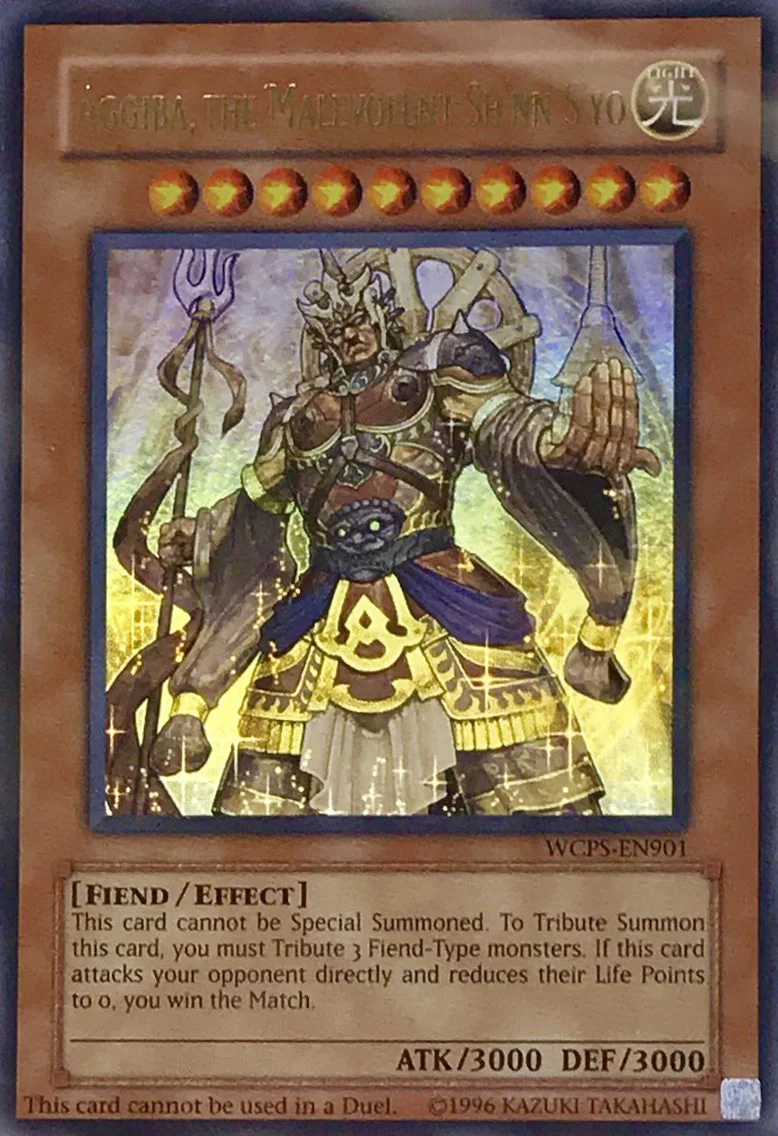 WCPS-EN901
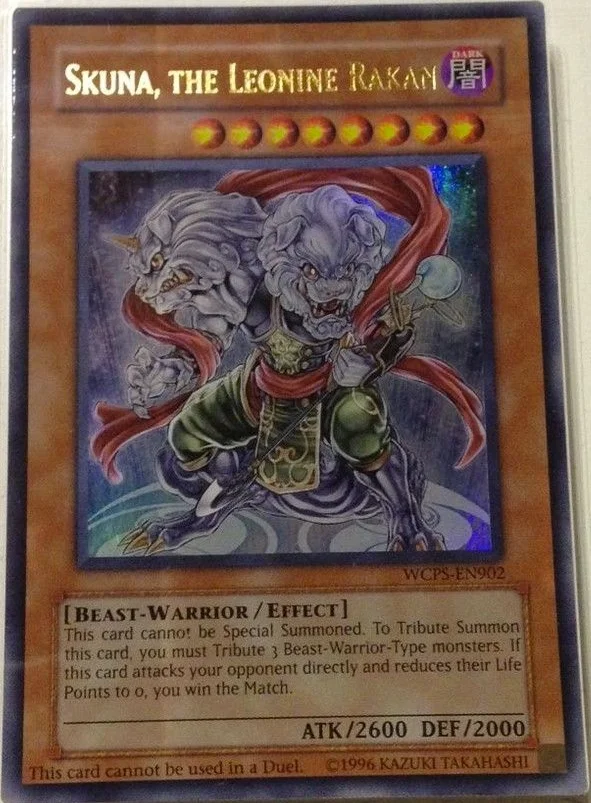 WCPS-EN902
Every card, year by year
Every print run here is approximate. The 2 and 6 figures come from the distribution rule and the community guide, which attributes them to official magazines. The qualifier figures are estimates.2
| Year and event | Card | Code | Placing | Approx. print run |
|---|---|---|---|---|
| 2003, New York | Victory Dragon | WCS-002 | Not recorded | 1 to 2, no proof of distribution |
| 2003, New York | Black Luster Soldier | WCS-003 | Not recorded | 1 to 2, no proof of distribution |
| 2003, qualifier | Kanan the Swordmistress | WCS-001 | Participation (Japan) | ~1,600 |
| 2004, Southern California | Ulevo | WCS-EN401 | 1st | ~2 |
| 2004, Southern California | Meteo the Matchless | WCS-EN402 | 2nd to 4th | ~6 |
| 2004, qualifier | Sengenjin | WCS-AE403 | Participation (Japan) | ~1,600 |
| 2004, tournament promo | Sengenjin | WCS-EN403 | Participation | No reliable figure |
| 2005, Tokyo | King of Destruction - Xexex | WCS-EN501 | 1st | ~2 |
| 2005, Tokyo | Queen of Fate - Eternia | WCS-EN502 | 2nd to 4th | ~6 |
| 2005, qualifier | Firewing Pegasus |
Open questions
- 2003. Nobody has confirmed whether Victory Dragon and Black Luster Soldier were printed, or who would have received them.
- Six or eight Meteos. The community guide and the top 4 math give six copies. A passage from Yugipedia, which we only saw in a search snippet, says eight. Both numbers may come from the same math, since there were eight prize cards in 2004 counting the two champion cards.26
- Asian-English Testament. The guide estimates 400 copies. Accounts from 2023 say 1,600.24
- English Sengenjin. The Toys "R" Us connection comes from the catalog date. Collector accounts say the card was given to people who attended the World Championship. Neither version is confirmed by Konami.35
- Extras. Nobody knows whether Konami printed copies beyond the ones handed out in those years.
Why it's hard
These cards almost never go to auction, and the values below are collector estimates from 2023, with no recorded public sale. Meteo sat around $50,000 to $60,000, and Eternia at $70,000 to $80,000. The other runner-up cards, between $40,000 and $60,000. For the 2006 to 2009 champion cards, the quoted floor was $100,000, with one Tyr listed for about $140,000. Xexex showed up at $300,000 to $400,000, and Ulevo above $500,000.34
Ulevo and Xexex never got a reprint, and collectors see that as part of the gap between them and the later champion cards.14 On the other hand, the qualifier Super Rares went for around $1,000 to $2,000 sealed, a real entry point if you want the artwork.34
To see the cards and trophies up close, the two Strictly Sealed videos listed in the sources are worth watching.
Comments
none yetCreate your free account to comment and save the cards from this article.
Get the next stories
One collection story every two weeks, straight to your inbox. Just reading, no ads.
You can unsubscribe anytime, in one click. See our Privacy Policy.


