Three giveaways, four cards
Almost every old Japanese promo is in Japanese. These four aren't. Two came out in Chinese and two in English, all Ultra Rare, and all of them went home with Japanese readers drawn by mail.123
The dates and counts below come from Yugipedia, which cites the magazine issues. We checked all three ads against the clippings hosted there.
| Giveaway | Magazine | Deadline | Winners announced | Card prize |
|---|---|---|---|---|
| e Jump | e Jump, Dec 1999 | Dec 23, 1999 | WJ 2000 No. 12 (Feb 21, 2000) and V Jump 2000 No. 4 | Blue-Eyes in Chinese, about a thousand |
| Dark Magician Giveaway | WJ 2000 No. 3-4 (Dec 20, 1999) | Jan 4, 2000 | WJ 2000 No. 10 (Feb 7, 2000) | Dark Magician in Chinese, about a thousand |
| Oversized Gift for 7000 People | WJ 2001 No. 27 (Jun 4, 2001) | Jun 18, 2001 | WJ 2001 No. 32 (Jul 10, 2001) | Blue-Eyes and Dark Magician in English, about a thousand of each |
WJ is Weekly Shōnen Jump. e Jump was a joint issue between it and V Jump, with a CD-ROM included. A collector who owns a copy dates it to December 10, 1999.6
A thousand winners in the ad, print run unknown
The number going around is the number offered. The ads promise a thousand winners, and none of them says how many cards were printed. A prize being offered doesn't prove the card exists. That's why we write "about a thousand," and the real figure could fall either way.
On the low side, there's a hint in the Blue-Eyes giveaway. The same collector checked both magazines that published the winners and found about 500 names in V Jump and about 90 in WJ. He says there's no way to claim all thousand copies went out.5 That's one person's reading, with no Konami document behind it.
On the high side, there's leftover stock. In 2018, the first print of Starter Deck 2018 very rarely included an old card in place of the token. Konami's official list includes all four from these giveaways, in the range of about 10 copies.89 Yugipedia calls this group stock promo cards.10 Eighteen years later, there were still copies in storage.
A thousand was what the ad promised. How many cards exist, nobody has published.
The Kowloon clue
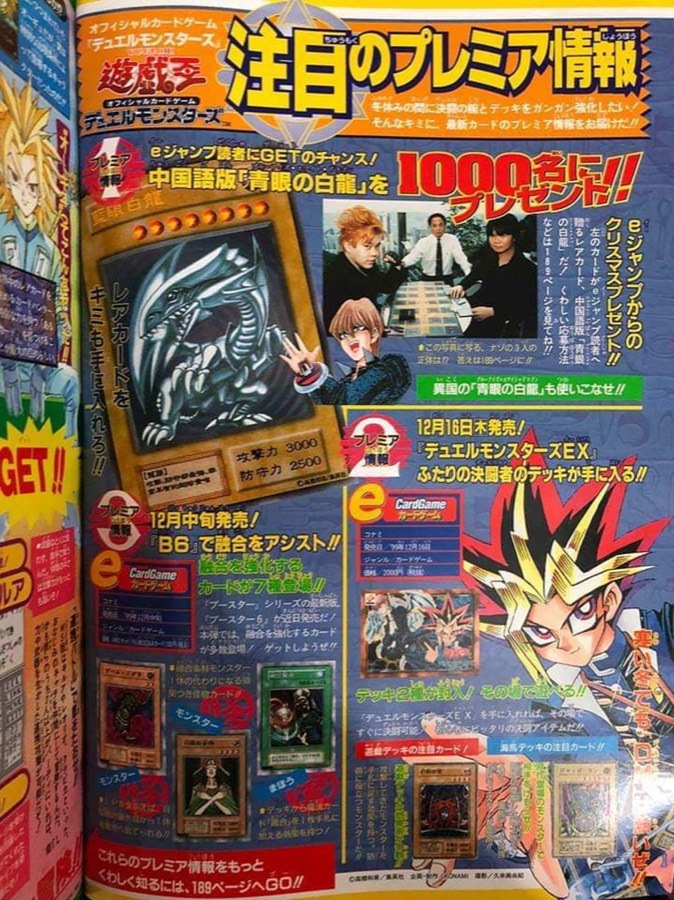 e Jump, opening page
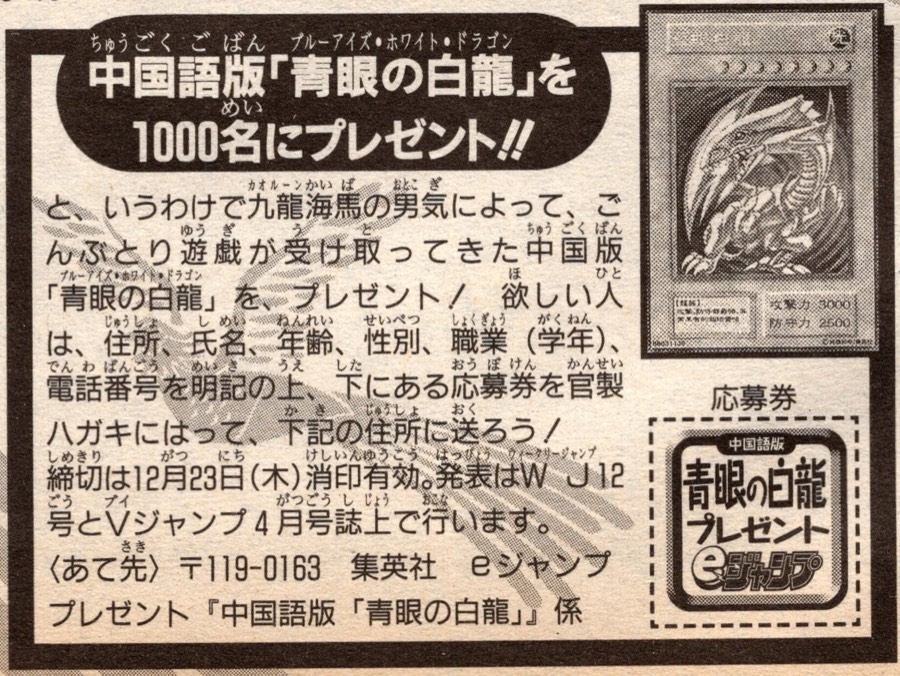 e Jump, entry box
No Yugipedia page explains why Chinese. For the Blue-Eyes, the magazine itself offers a clue.
The opening page treats the card as a Christmas present, shows three people around a dueling table and asks who they are, with the answer on page 189. The headline tells readers to master the Blue-Eyes "from a foreign land" too. The entry box says the card arrived thanks to the "Kaiba of Kowloon," and that it was received by someone called "Gonbutori Yugi."4 These are nicknames, and we don't know who is behind them.
Kowloon is in Hong Kong. The collector who owns the magazine sums it up as an OCG exchange between the editorial staff and Hong Kong duelists, and says the giveaway celebrated that meeting.56 We haven't seen the full feature, only the opening page and the box.
Two clues point to the same place, and neither is proof.
- The manga. In Duel 27, Kaiba says there were four Blue-Eyes in the world: one in the United States, one in Germany, one in Hong Kong and Grandpa's.13 The collector guesses that the Chinese version in Structure Deck: Kaiba nods to that card taken in Hong Kong.7 That's his guess, and the link to the "Kaiba of Kowloon" is ours.
- The card text. In the available images, the Blue-Eyes text ends in 咭, the Cantonese word for card.14 A Chinese collector's guide also sees a Hong Kong style of translation in it.15 That reading is ours, based on a low-resolution image.
The Dark Magician still has no reason
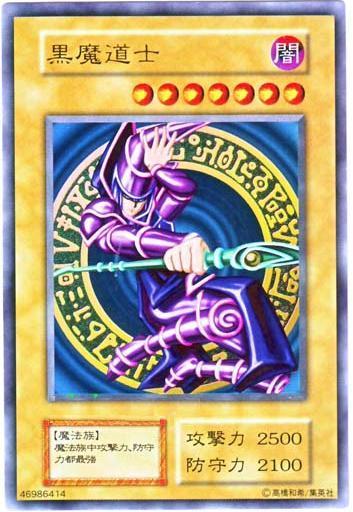 no code · 黒魔道士
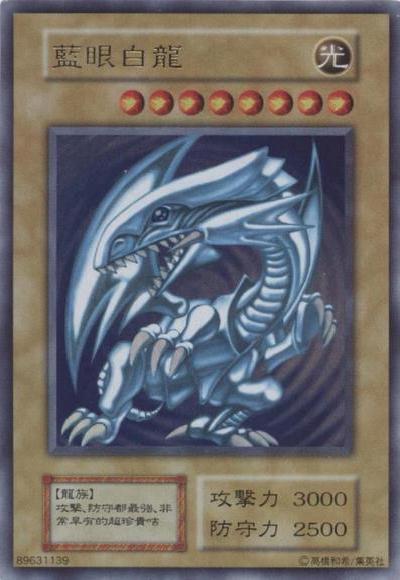 no code · 藍眼白龍
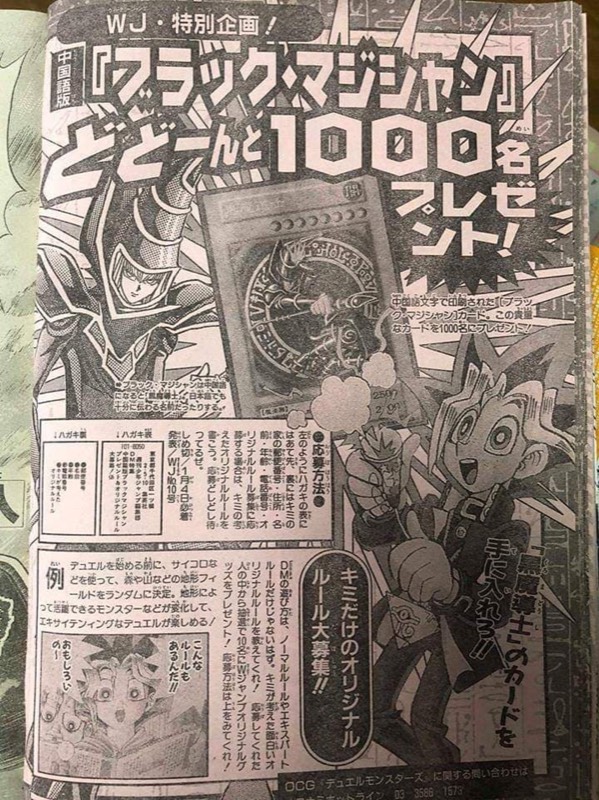 WJ 2000 No. 3-4
The WJ ad came out days after e Jump and doesn't mention Hong Kong. It calls the promotion a special project, points out that the card was printed in Chinese characters and jokes that you can still understand the name in Japanese. On the same page, the magazine asked readers to send in made-up dueling rules.1 It looks like a companion to the Blue-Eyes, but that's our impression, and the ad doesn't say so.
That leaves the central question. Konami only launched an official Traditional Chinese line in 2014, and it lasted until 2016.11 In 1999, someone ordered Chinese cards printed to give away in Japan, and no source says who asked for them, whether there was a plan to sell in Hong Kong, or whether it was all just a magazine stunt. For the Blue-Eyes, we have a scenario. For the decision to print, we still have no answer.
The English cards have their reason printed
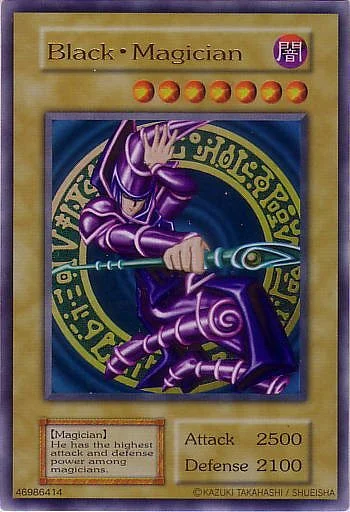 no code · Black・Magician
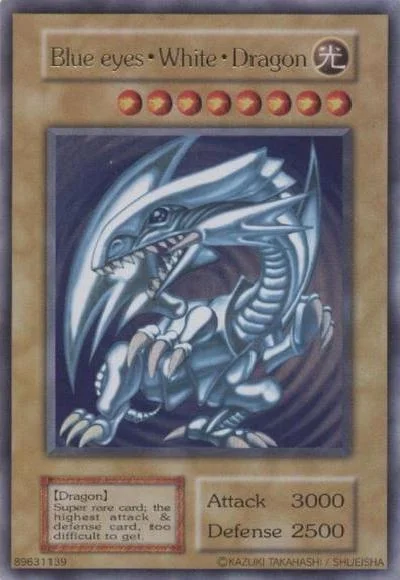 no code · Blue eyes・White・Dragon
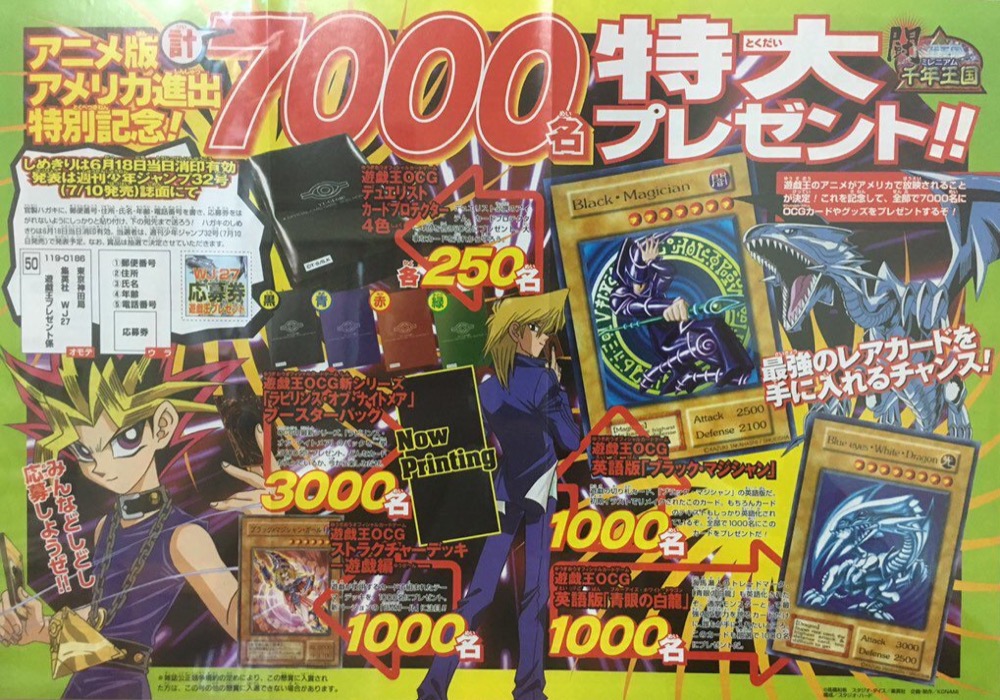
In 2001 there's no mystery. The ad says the giveaway celebrates the decision to air the anime in the United States.3 There were about 7,000 prizes: the two English cards, Structure Deck: Yugi, Labyrinth of Nightmare boosters, deck boxes and sleeves.3
The cards look like an experiment. The names came out as Black・Magician and Blue eyes・White・Dragon, translated straight from the Japanese and set in the OCG font.12 The Blue-Eyes text opens with "Super rare card," far from anything the TCG would use. The layout is Series 1, in the middle of Series 2.3
The winners were announced in July 2001, eight months before LOB-001 reached North America.16 These are English cards from before English cards. If you like this kind of detour, also read our article on the Barrel Dragon from Valuable Book 5, another English card given out only in Japan.
The cousins that muddy your search
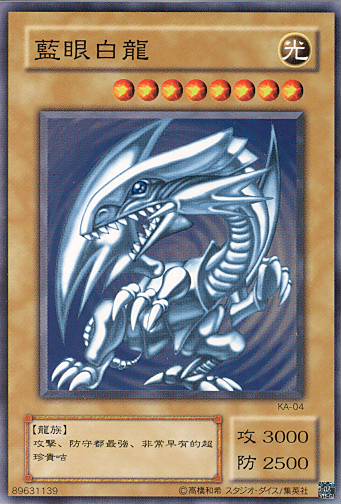 KA-04
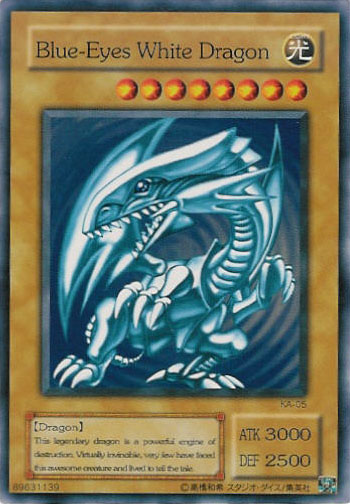 KA-05
The roughly-a-thousand range applies only to the Ultra Rares. On January 24, 2002, Structure Deck: Kaiba came with three Common Blue-Eyes, each in a different language: Japanese, Chinese and English.17 KA-04 repeats the name 藍眼白龍 and, as far as we can read, the same Chinese text. KA-05 uses the TCG text.7 In other words, there is a Chinese Blue-Eyes from a retail product, and searching for 藍眼白龍 mixes the two.
Open questions
- Who ordered the Chinese printing, and whether there was a commercial plan for Hong Kong. No Konami or Shueisha document has turned up.
- Who the "Kaiba of Kowloon" and "Gonbutori Yugi" are, and what the e Jump feature says.
- Whether the Chinese Dark Magician has the same origin as the Blue-Eyes.
- How many cards exist. A collector's count of 1,011 Chinese Blue-Eyes starts from the thousand offered and doesn't settle it.5
- The official origin of the Blue-Eyes. Konami's 2018 list says January 2000 V Jump.8 The ad is from e Jump, and the collector says that V Jump issue had no such giveaway.5
- The origin of the English cards. The same 2018 list gives them as Weekly Shonen Jump 2000 No. 27.9 The ad and Yugipedia point to 2001, which fits the anime's US debut.3
- Whether the 2018 copies differ physically from the 1999–2001 ones. We found no reports.
Comments
none yetCreate your free account to comment and save the cards from this article.
Get the next stories
One collection story every two weeks, straight to your inbox. Just reading, no ads.
You can unsubscribe anytime, in one click. See our Privacy Policy.